Incoming! School-Bus-Sized Asteroid 2026 JH2 Skims Past Earth Today
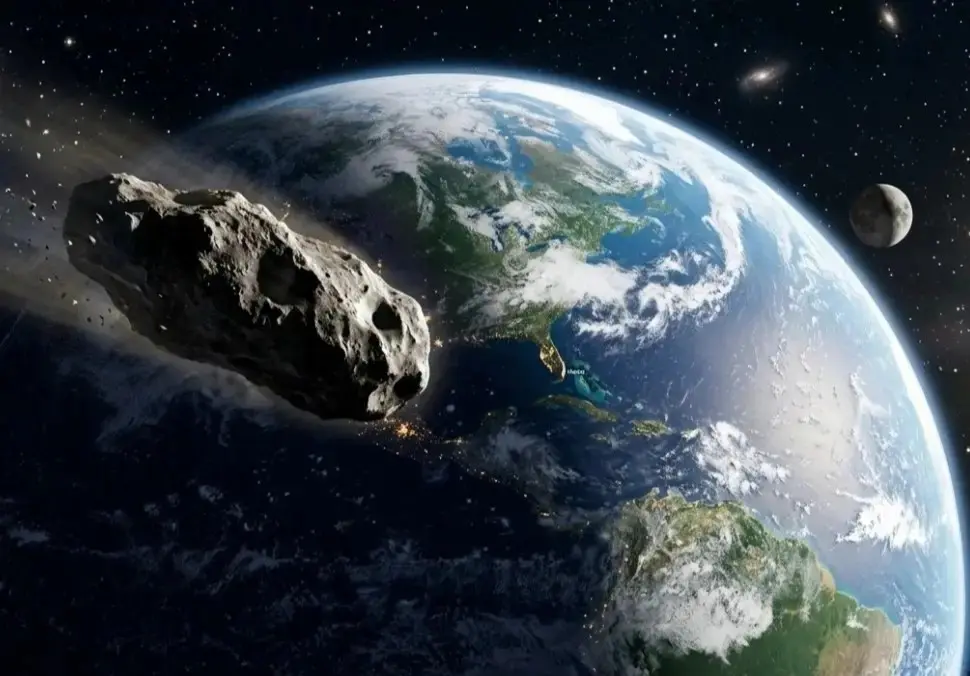
Spotted just eight days ago, asteroid 2026 JH2 makes its closest approach to Earth today at roughly 90,000 kilometers — inside the Moon's orbit, detectable by backyard telescopes, and carrying zero risk of impact.
Eight days. That is all the warning the planet had. Asteroid 2026 JH2 was first picked up on May 10 by the Mount Lemmon Survey, a sky-scanning facility in Arizona that forms a cornerstone of the global network watching for objects on Earth-crossing trajectories. At the moment of initial detection, it was faint — apparent magnitude 21, far below what any amateur instrument could see, briefly logged under the provisional designation CELU1Q2 before observers began to piece together what it was. By May 12, follow-up observations from Steward Observatory, Farpoint Observatory, and the Magdalena Ridge Observatory had pinned down the orbit and the object was formally classified as an Apollo asteroid — a category defined by trajectories that cross Earth's own path around the Sun. The close approach date was already on the calendar: Monday, May 18, 2026. Today. Asteroid 2026 JH2 will reach its closest point to Earth at 21:23 UTC, passing at a distance of approximately 90,000 kilometers — 56,000 miles — from Earth's surface. To place that number in context: the average distance from here to the Moon is 385,000 kilometers. This rock will pass at just under a quarter of that distance, well inside the Moon's orbital path but still comfortably beyond the belt of geostationary satellites that ring Earth at around 36,000 kilometers. There is no risk of impact. Astronomers have confirmed that with the kind of precision that modern orbital mechanics makes possible — trajectory projections can be trusted decades out, and 2026 JH2 does not appear on any of them as a concern. The asteroid measures somewhere between 16 and 35 meters across, according to estimates from NASA's Jet Propulsion Laboratory Small-Body Database. The upper end of that range puts it roughly the width of a basketball court. The comparison that planetary scientists keep returning to is Chelyabinsk — the roughly 20-meter asteroid that entered the atmosphere above Russia's Ural region in February 2013 without any advance warning whatsoever, detonating at altitude with the energy of approximately thirty Hiroshima bombs and sending a shockwave through the region that shattered windows across six cities and injured more than 1,500 people, most of them from flying glass. 2026 JH2 sits squarely in the same size class as Chelyabinsk. It is not going to hit Earth. But the comparison is not idle. NASA's own guidance holds that objects smaller than roughly 25 meters would most likely burn up in the atmosphere before reaching the ground, causing little or no surface damage. 2026 JH2 falls close enough to that threshold that any entry scenario — which is not happening — would be ambiguous in outcome. What is not ambiguous is the significance of the eight-day window between discovery and closest approach. Chelyabinsk arrived completely unseen. Eight days is not much, but it is the difference between a surprise and an event that the global astronomy community could prepare for, study, and broadcast.And broadcast they have. The Virtual Telescope Project, an Italian-run remote observatory network that has made a practice of live-streaming significant astronomical events, began its coverage feed at 19:45 UTC — nearly two hours before closest approach — specifically to catch the asteroid at peak brightness. At closest approach, 2026 JH2 is expected to reach an apparent magnitude of approximately 11.5, putting it within range of a small amateur telescope under reasonably dark skies. The asteroid is tracking through the southern sky after sunset, positioned near the constellations Ursa Major and Leo for observers in the northern hemisphere, though its declination will carry it into southern latitudes as the night progresses.The shortness of the warning window is, in some respects, the real story here — not because it represents a failure, but because it illustrates exactly the kind of gap the planetary defense community has been working to close. Small, dark asteroids are genuinely difficult to find. They absorb more sunlight than they reflect, making them dim against the sky, and they are only detectable by ground-based surveys when they are already relatively close. The Mount Lemmon Survey caught 2026 JH2 at magnitude 21, which represents a detection at the edge of what current wide-field survey equipment can reliably achieve. A slightly darker surface composition or a slightly different approach geometry and the object might not have been identified until it was already past.Mark Norris of the University of Central Lancashire put the situation plainly. In astronomical terms, he said, it is as close as you can get without hitting. That framing captures both the dramatic geometry of the event and the reason scientists take routine interest in it even when, as today, there is no danger. Every close approach that is detected in advance is a data point. Every data point improves the models. The models are what give planetary defense its operational meaning.The Apollo asteroid designation carries its own history. The Apollo class takes its name from the first asteroid of this type identified, discovered in 1932. It encompasses objects whose orbits cross Earth's path around the Sun — not necessarily objects on a collision course, but objects whose trajectories intersect the region of space where Earth spends its time. There are thousands of known Apollo asteroids. Many of them are tracked continuously. Others are catalogued and then monitored intermittently as they cycle through their orbits. Some, like 2026 JH2, turn up close and fast, with barely enough notice to do more than confirm the orbit and point the cameras.The planetary defense architecture that caught this one is a patchwork of survey telescopes, follow-up observatories, coordination centers, and data-sharing agreements that has grown considerably more capable over the past two decades. NASA's Planetary Defense Coordination Office, established in 2016, sits at the center of that network on the American side, tracking incoming objects and coordinating with international partners including the European Space Agency's Planetary Defence Office. The system is not perfect — Chelyabinsk proved that — but it is considerably better than it was, and 2026 JH2 is arriving on time, observed, catalogued, and live on the internet. For most of the planet, today's closest approach will pass unnoticed. The asteroid is too faint for the naked eye. It will not produce a sound. It will not register on any instrument a layperson would encounter. It will simply complete its geometry — a basketball-court-sized rock moving at roughly 32,000 kilometers per hour, curving past a planet it will not touch — and continue along an orbit that will carry it back out into the solar system. The researchers watching it through their telescope feeds will log the brightness curve, note the time of closest approach, update the orbital solution, and add one more data point to a catalog that grows with every pass.